

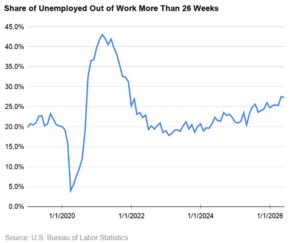
Nearly two million Americans have now been out of work for six months or longer. The long-term unemployed made up 27.3% of all unemployed people in June, up four percentage points from a year earlier and nearly 40% higher than pre-pandemic in January 2019.
By many measures, the labor market looks fine. The economy has added jobs for four straight months. Unemployment has drifted down to 4.2%. Layoffs remain historically low.
So which is it? Is the market healthy or is it not?
We’d argue it’s both, depending entirely on which side of it you’re standing on.
If you have a job right now, the market is treating you well. Layoffs are low. Your employer is probably holding onto you, maybe even hoarding you, because they remember how hard it was to hire in 2021 and 2022. You are, statistically speaking, quite safe.
If you don’t have a job, it’s a very different market. Hiring as a share of employment has barely moved in two years. The quits rate has been at or below 2% for almost a year, a level last observed around 2015. And as we’ve written about before, most openings in a normal market are created by turnover, by someone leaving a seat that then needs filling. When nobody quits, those seats never open. New entrants, recent grads, and the recently laid off are all competing for a small number of truly available positions.
The market isn’t loose. It isn’t tight. It’s just mostly pretty static. And a static market is fine for the people inside but a different story for the people trying to get in. And the white-collar side of the market, the part most exposed to AI, flattened org charts, and post-pandemic overhiring corrections, is where the door has been hardest to reopen. More than a third of unemployed workers in professional services have been out for six months or more, with finance, information technology, and government not far behind.
There’s an uncomfortable wrinkle here that we see in our work: the longer someone is out of work, the harder it gets. Some of that is skills and momentum. But some of it is an adverse selection problem. In a market where layoffs are rare, hiring managers start to wonder why this particular person was let go, and why nobody has scooped them up since. It’s often an unfair inference. Plenty of good people get caught in a bad quarter, a restructuring, a reorg that had nothing to do with them. But fair or not, the question gets asked, and six months out of work starts compounding on itself.
Meanwhile, certain pockets remain as hard to hire for as ever. Try finding an experienced electrician. An industrial maintenance tech. Welders 30 miles out of city center. The freeze is not evenly distributed. Whole categories of the workforce never thawed in the first place.
Adding up the factors points to one potential outcome: If the surplus is increasingly white collar and the shortage is increasingly blue collar, some amount of movement between the two seems inevitable. The WSJ article linked in the opening sentence included an anecdote about an accountant who, after a year and a half out of work, is considering becoming a locksmith. We suspect he won’t be the last. But this shift will be slower and messier than the economics suggest it should be. Some trades take years of training. Career identity is sticky. And the wage signal has to get a lot louder before a laid-off analyst enrolls in an apprenticeship. Which, for what it’s worth, is exactly why we expect the trades to stay tight for years even if white collar softening continues.
So what would we offer employers? We don’t see a path where hiring gets meaningfully easier. If the economy softens, the freeze deepens and the line outside gets longer. If the economy accelerates, companies will be competing for a labor pool that demographics have already constrained. And if AI displacement picks up speed, which it may for white collar roles, it adds people to the outside of a market that has very little absorption capacity.
Yet we think this is one of the better moments in years to be a proactive hirer. The long-term unemployed pool contains a lot of genuinely capable people carrying an unfair discount. If your process can tell the difference between someone caught in circumstance and someone let go for cause, you can hire quality that other companies are screening out on autopilot. The interview costs you thirty minutes. The bias costs you the candidate.
The headline says the market is fine. Below the surface, it depends a great deal on where you’re standing. Or how you’re looking at it.
Until next time,
Your Spherion WI & Northern IL team